2017
On a Deathwatch
Digital Archiving
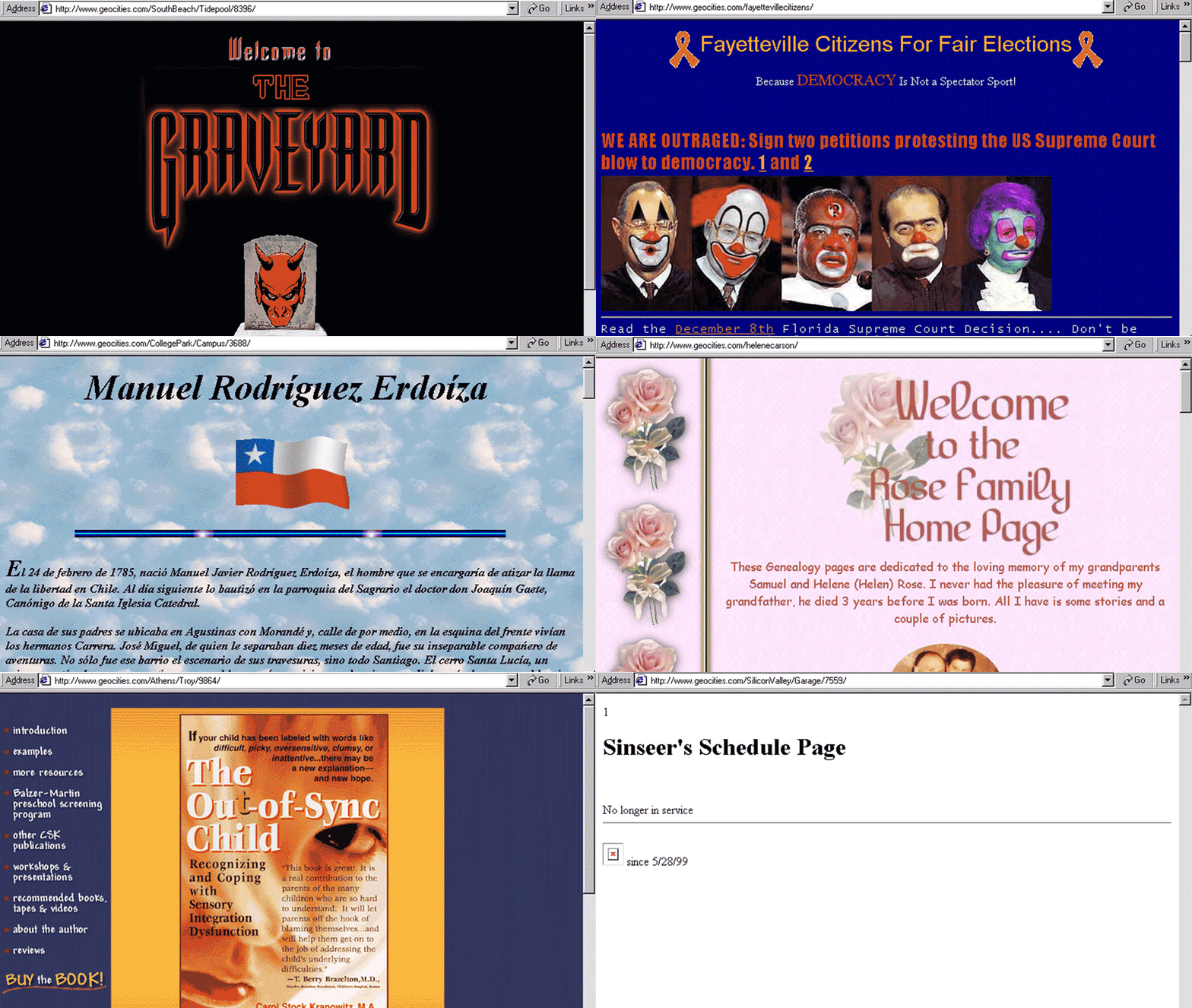
They were ephemera and phenomena on the face of a contemporary scene. That is, there was really no place for them in the culture, in the economy, yet they were there, at that time, and everyone knew that they wouldn’t last very long, which they didn’t.
— William Faulkner, letter, 7 March 1957
Jason Scott, the founder and public face of the Archive Team, demands attention as much for his wardrobe as for his idiosyncratic archiving philosophy. Wearing a stunning range of comical costumes to tech-conferences, he has an eclectic personal style which combines black shirts with skull patterns, steampunk goggles, pirate fancy dress, vintage coats, hawaiian shirts, and bow ties with formal suits. His wardrobe is as diverse as the stories of superheroes and other fictional narratives that Scott uses to describe the Archive Team, a loose gang of geek volunteers on a mission to save dying online platforms.
Since 2009 the Archive Team has saved millions of web pages from oblivion. Their archival activism reflects a shift of attitude, one in which the Web is no longer viewed as an archive itself but as a place which is constantly re-edited and where business shutdowns are effectively destroying the record of our recent creative history. The Archive Team’s efforts, however, follow no established protocol; there is no recipe for digital archiving. Theirs is an improvised method, a form of guerrilla warfare against a larger system in which the authority of service providers is usually taken for granted.
Taking control over digital archiving is taking back control over our data; an act which removes us from a mere position of an observer on a Deathwatch, and sets ground for future communities whose interests in preservation are beyond surveillance or marketing.
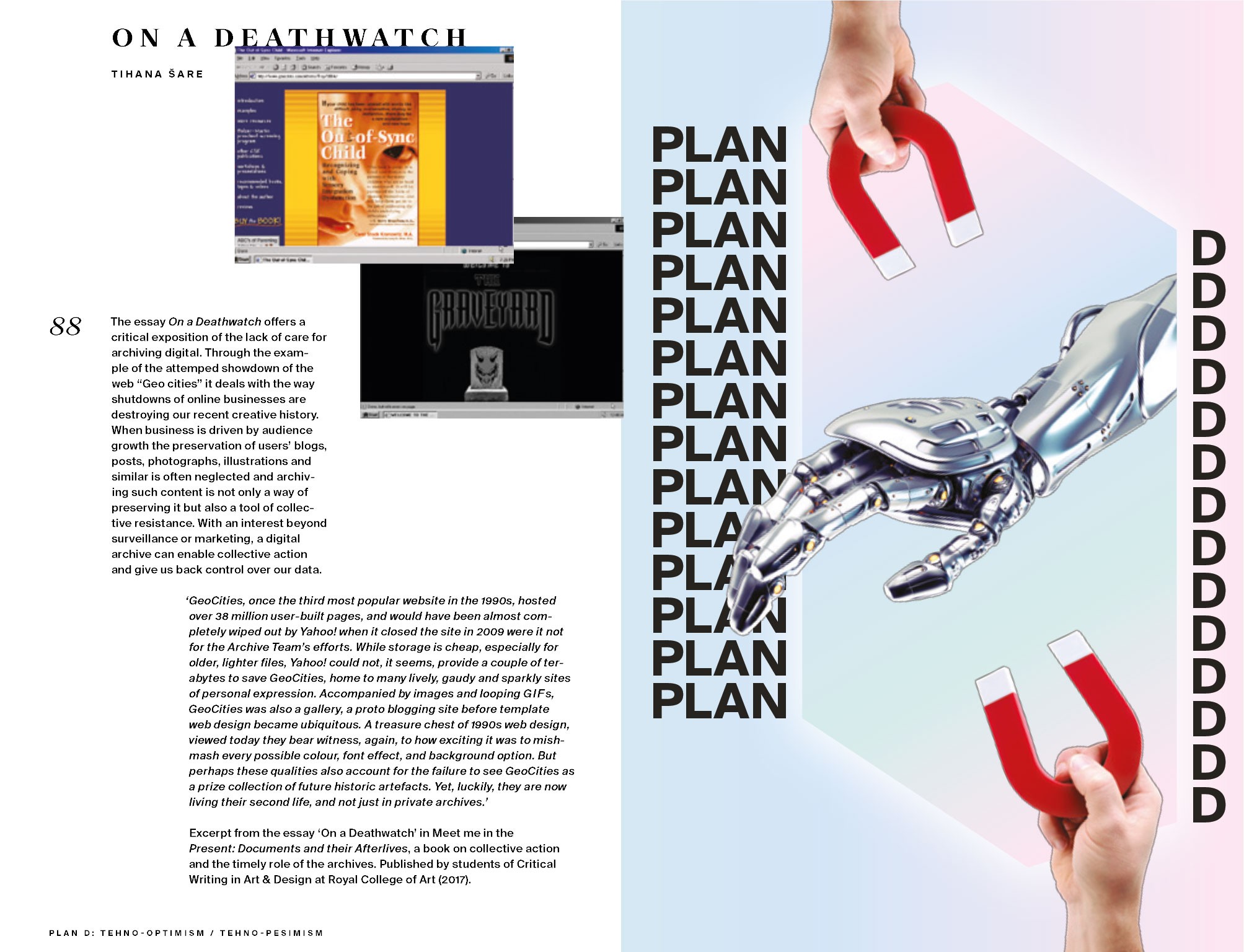
This pamphlet was printed as a companion for ‘On a Deathwatch’ exhibit at Plan D Techno-optimism/Techno-pessimism International exhibition of Young Authors in Zagreb (27.09–1.10.2017). ‘On a Deathwatch’ essay was first published in Meet Me in the Present: Documents and their Afterlives (June 2017), written and edited by postgraduate students on the Critical Writing in Art and Design programme at the Royal College of Art in London.
For Scott, his archival passion seems to fill his life, literally. At Open Source Bridge 2012 he gave a presentation on ‘Open Source, Open Hostility, Open Doors’, where he showed images of his house, cluttered with magnetic tapes, CDs, and hard drives. Data storage discs, stacked one on top of another, form building blocks in this hoarder’s house. Yet his surroundings provide few clues to his personality. It’s as straightforward as a stock photo; a warehouse of an obsessive collector with a serious working agenda: ‘Let’s save as much as we can, because everybody, apparently, is trying to destroy everything as fast as possible.’¹
Among their other activities, the Archive Team is currently fighting to preserve Google’s open source code repository named Google Code: URL shorteners; wiki sites with their external links; Yahoo! Answers; Vine videos; and public files hosted by the United States government.² Archiving is the very core function of their activism. What started in 2009 as a sense of injustice over the lack of care for users’ content displayed by corporations like Yahoo! or Ma.gnolia, the Archive Team has grown into an open source project run by volunteers, developers, and archivists. They are watchmen, keeping an eye open for signs of instability in the online economy such as new acquisitions, changes in operating policies, or announcements of service closures. And ‘The Deathwatch’ is part of their wiki site where they list those companies.³ In 2014, for instance, ImageShack first appeared on the Archive Team’s radar. The site has crippled many blogs by changing its pricing policy from a free to a paid model, and deleting free-account holders’ images that had been hosted on its servers for many years. The Archive Team keeps track of ImageShack and, as of February 2017, reports its ‘vital signs’ on ‘The Deathwatch’ as being: ‘Stable. Probably worth keeping an eye on’.⁴
…to read the full text, download this pamphlet.
All links are last accessed on 8th of February 2017.
Jason Scott, Open Source Bridge 2012, online video recording, Open Source Bridge.
As listed on 8th of February 2017. on the Archive Team’s homepage.
‘Deathwatch’ section on the Archive Team’s wiki site.
‘ImageShack’ section on the Archive Team’s wiki site.